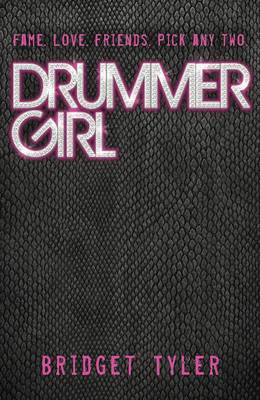
.jpeg) You may remember my review of Drummer Girl from a weeks back - this addictive tale of a group of London school girls winging their way to LA to take part in a reality show is a great page turner with the snappiest of snappy dialogue. Today I welcome author and screenwriter Bridget Tyler to my blog to chat about pop culture, friendship and happy endings in YA...
You may remember my review of Drummer Girl from a weeks back - this addictive tale of a group of London school girls winging their way to LA to take part in a reality show is a great page turner with the snappiest of snappy dialogue. Today I welcome author and screenwriter Bridget Tyler to my blog to chat about pop culture, friendship and happy endings in YA...What first drew you to writing for young adults and what were your favourite reads at this age?
- I love
writing for Young Adults because I think great stories about growing up have
more impact on us over the course of our lives as readers than any other kind
of book. I still remember the books I loved when I was a teenager vividly – The
Chronicles of Prydain by Lloyd Alexander, the Nancy Drew series, The Dark is
Rising series by Susan Cooper, anything by Anne McCaffrey, Harry Potter… the
list goes on. Those characters, and their journeys, helped me understand and
survive my teenage years and I will never forget them. If I can tell just one
story that makes someone else feel that way, then I will consider myself a
success.
Pop
culture and current trends are a major part of Drummer Girl – what do you think
are the pros and cons of writing about music in YA?
- Obviously,
anything related to pop culture is dangerous in a book because it is bound to
be out of date in a heartbeat. That’s why, as much as Drummer Girl takes place
during a reality competition, I worked hard to avoid too many references to
contemporary pop culture. You’ll notice as you read that most of the specific
references made to bands are either to icons like Madonna and the Beatles, or
to fake bands that only exist in the world of Drummer Girl. I even tried to
stick to fairly classic styles when mentioning clothes, hair and make up while
still being on trend. I used the framework of reality television and the music
business, but I really wanted to be sure Drummer Girl was also about these five
girls and their friendship not about the world they find themselves in.
 You’ve
clearly got a knack for both authentic US and UK dialogue – how does writing
dialogue for novels differ from screenwriting?
You’ve
clearly got a knack for both authentic US and UK dialogue – how does writing
dialogue for novels differ from screenwriting?
- Not much,
actually. Whether I’m writing a book or a screenplay, I read the piece out loud
to myself many, many times before it’s finished. It’s really the only way to
tell if dialogue is going to ring true or not, at least for me. The biggest
difference with the dialogue in a novel is that you don’t have to make the
characters say as many things out loud. In a script, I might need a character
to say, “Wait. Mum can’t possibly know we cut school last week. She spoke to
Mrs. James this morning and neither of us is grounded. What are you up to?” because
otherwise the audience has no way of knowing what’s happening in the
character’s head. In a novel, I might do
this instead:
Molly stopped short, starring at her sister as she dug through her
dresser drawers. No matter what Jane said, Mum couldn’t possibly know that
they’d cut school. She’d spoken to Mrs. James this morning and everything.
They’d be beyond grounded if either had a clue. So what was Jane up to?
See
the difference? Finding organic and natural ways for characters to say what
they’re thinking out loud is actually one of the most challenging aspects of
screenwriting.
Friendship
is a strong theme in Drummer Girl – do you think this is something we should be
seeing more of in YA and what other themes do you think deserve more attention?
- Yes, I
think friendship, particularly female friendship, is highly under utilized in
YA and in storytelling in general. Friends are such an important part of the
growing up experience – good friends make everything so much better and bad
ones can be downright dangerous, in the wrong situation. Romance is fun, and
there’s a lot of that in Drummer Girl too, but it isn’t the only kind of
relationship out there to explore. As for other topics that could use more
attention, this isn’t exactly a theme but I have to say I think it’s important
for YA writers to create more characters who are into science, female
characters in particular. Too often math and science gets ignored, or even
vilified, in teen literature. Those fields are both truly fascinating and very
important for the future – we should be telling stories that encourage people
to be interested in them.
Drummer
Girl has an incredibly fast-paced plot – how do you ensure that this is
balanced out with strong characters?
- Well this
is another trick that comes from screenwriting – plotting that doesn’t develop
the characters is going to end up being boring and character development that
doesn’t advance the plot has a good chance of ending up on the cutting room
floor. The goal is to make every new twist and turn of the plot service the
characters so that you don’t need to slow down and take a detour in order to
develop them.
And
finally, how important do you think ‘happy endings’ are in YA?
- I think
every story deserves the ending that best fits it. Some stories end well, some
don’t. There are happy endings in Drummer Girl and very, very sad ones. And a
few that are in between. That’s the way life is. The one thing I do think all
stories should have is hope. I think there is a place in the world for bleak
stories that lack hope for the future, but they aren’t the kind of stories I
chose to tell, nor are they the kind of stories I like to read.
I'd like to thank Bridget for taking the time out to answer my questions and in particular, those very handing tips on writing dialogue. So thank you Bridget - I'm certainly looking forward to your future YA titles! And it's always nice to find a fellow Nancy Drew fan...
